
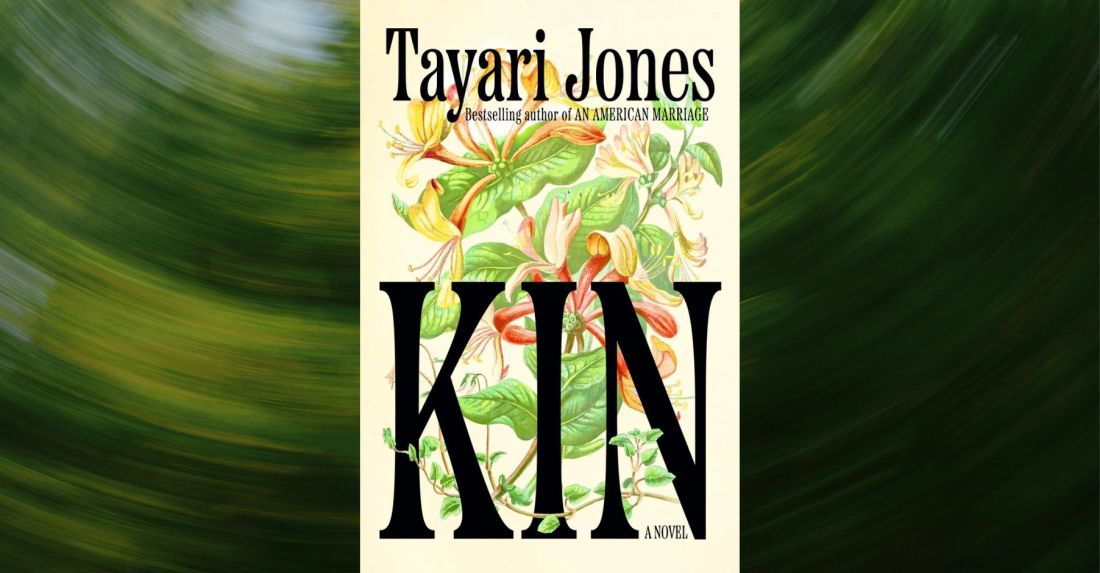
Tayari Jones chose the perfect opening sentence in her new novel, Kin. “My first word was ‘mother,’ spoken out loud and with texture. MOTHER.” With that, we are introduced to Vernice, nicknamed Niecy by her best friend, Annie.
Niecy and Annie have been friends since they were babes in the same cradle, growing up in Honeysuckle, Louisiana. Both girls shared a fate no child, but especially a little girl, would ever wish – they grew up without their mothers. When Annie was only three days old, her mother, Hattie Lee, nursed her one last time before handing her over to her grandmother and leaving town. Meanwhile, when Niecy was only a couple of months old, her father took his own life, but only after he’d killed her mother first. Niecy’s wayward aunt Irene was left to fill in as her guardian and maternal role model, though Irene herself never wanted to be a mother.
It is with these losses that Niecy and Annie are bound together, yet they are total opposites in almost every other way. Annie is the stormier of the two and headstrong in finding her mother one day, while Niecy is always more careful and guarded. As Annie puts it, “Nobody would for one second think to call me shy if I stood next to Niecy — who has been a young lady since the day she was born. And with me around, nobody would ever call Niecy poor or homely. In that way, we kept each other from being the thing we most didn’t want to be.”
When the girls are eighteen, Annie follows in her mother’s footsteps and runs away from Honeysuckle and heads to Memphis in search of Hattie Lee. Meanwhile, Niecy plays by the rules, applies to college, and saves up to attend Spelman College in Atlanta. Their lives diverge in action and location, but these motherless women never leave each other at heart. Annie meets new friends in Babydoll, Clyde, and Bobo. Their crew first works at a whorehouse, then a bar. Annie is always in search of her mother. Niecy, on the other hand, is fully enveloped in college life and meets the likes of Joette and Marylinda, then eventually Mrs. McHenry, who becomes a surrogate mother figure to her.
Even still, with all the searching, with all the role-filling, Annie and Niecy never feel fully whole, never fulfilled. Niecy says, “Annie and I were two motherless girls who grew into motherless women.” Their circumstances have maybe changed, but their quiet yearning never ceases. Life happens, years pass, and when a crisis occurs, Niecy and Annie come back together as the motherless women they are in order to make sense of it all.
“And then we unscrewed the cap off our feelings and we sat there on South Main Street, two cradle friends, with me weeping like Mary and her moaning like Martha. My sorrow was for what had already happened and hers was just around the bed. It was how we were as friends. Not the same, but still the same.”
Perhaps what’s most enrapturing about this story of perseverance and womanhood is not only the sweeping and emotionally charged story of friendship and belonging, but how the lives of these Black women run parallel in the 1950’s-60’s Jim Crow South. Not only do Niecy and Annie have internal struggles to contend with, but externally, they are living in a world that wasn’t made for them to succeed. Much like her previous book, American Marriage, Jones is able to bring social justice to light within her storylines and mesmerizing characters. Not to mention, Jones has an incomperable way with words. In describing her characters, Jones writes, “That girl is sadness in a skirt,” and, “It was like he opened up his mouth and God tossed in a handful of teeth, not caring what went where.” These sentences are small in stature but grand in description.
At its core, Kin is an exploration of self-discovery, the brutality of racism and inequality, and above all else, a study of sisterhood, motherhood, and the unconditional love found in those relationships. Woven throughout the entire story is that indestructible need for a mother’s love and presence.
“So there we were, kitty-corner from Hattie Lee’s address, each one of us eating her heart out over her whole motherless life. We were also fatherless, but this didn’t bite the same way. When you don’t have your mother, you don’t really know who you are. Even if you have a bad mother like Babydoll had, you can use her to know what you are not.”
The constant need and ache to know who you are can sometimes only be found in the love of a mother. But, perhaps, it can also be found in that of a friend. One so unconditional and resolute that life without them is unthinkable.
At some point, Niecy realized, “It is sad to not have a mother. It is sad to be incomplete. But sadness is one thing. Grief is another.” And this is where we find the meaning of not only Kin the novel, but the word “kin” as well. Kin, family, is not defined by blood, but by the people who show up in your life, day after day, year after year, and hold space for who you are, the good and the bad. Real kin will tell you the hard stuff, wipe your tears, and hold your hand and heart through it all. Amidst so many other beautiful elements, this novel truly captures what it means to be Kin.
FICTION
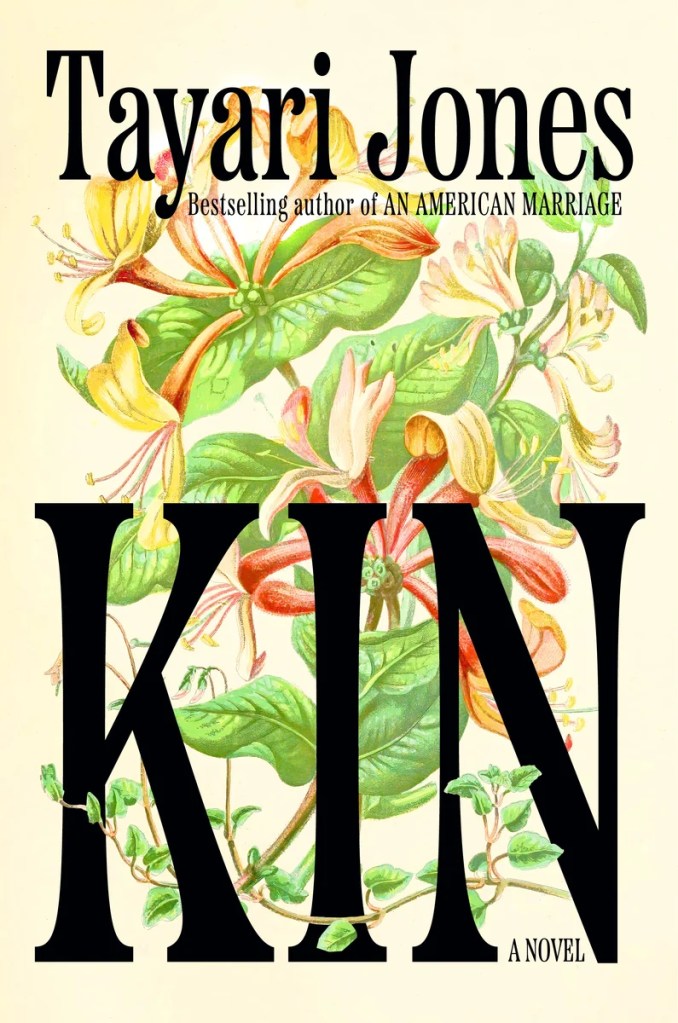
Kin
By Tayari Jones
Knopf
Published February 24, 2026


